The original plan was to play all of the New England states and possibly catch the state of Michigan on the way home. After driving to Arcadia, the ferry boat across Lake Michigan into Wisconsin made it an easy decision to add one more state before the end of our trip. The ferry boat even docked in Manitowoc, a short 20-miles north of the course I planned to play in Wisconsin.
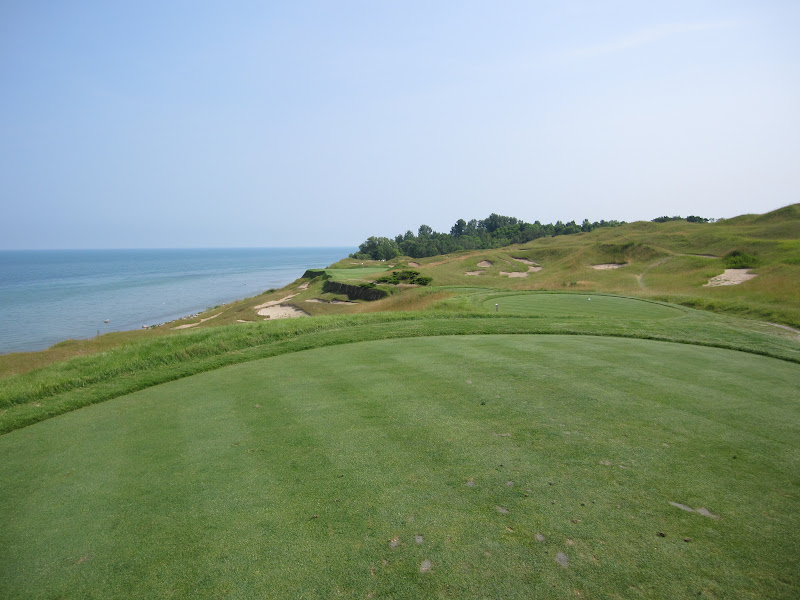
Open, rugged and windswept terrain defines the walking-only, links-style Whistling Straits course sculpted along two miles of the Lake Michigan shoreline. The Straits course was ranked #3 in Golf Digest's ranking of America's 100 Greatest Public Golf Courses for 2011/2012. It has hosted the 2004 PGA Championship, the 2007 U.S. Senior Open and the 2010 PGA Championship since the course was opened to the public in 1998.
Before the course was built, the property was a featureless abandoned airfield called Camp Haven. Its one saving grace was 2-miles of frontage on Lake Michigan. Kohler Company CEO Herbert Kohler signed up Pete Dye as the course architect. The Straits course replicates the ancient seaside links courses of the United Kingdom and Ireland with vast rolling greens, deep pot bunkers, grass-topped dunes and winds that sweep in off the lake.

The club house at Whistling Straits

Round: #37
Location: Haven, WI
Golf Digest Best-In-State Rank: #1
Date: 2 Jul, tee off at 11:00 AM
Conditions: sunny, 5 MPH wind, 81 degrees
Yardage: 6,663
Lost balls: 0
Lost balls: 0
Score: 81 on a par 72
My playing partners were two Serbian brothers who grew up in Milwaukee. Stefano Maldenovic was the older of the two; he attended college at Arizona State University where he played on the hockey team. Although he looked solid enough to be a hockey player, I questioned his hockey background when he failed to trash-talk his brother following a poor shot. After graduating from ASU, he worked for the Chicago Black Hawks professional hockey team for a year. He has lived in Scottsdale, Arizona for the past 2-1/2 years where he is employed by the CVS chain of drug stores.
Dushan was the younger of the two brothers. He is a student at Arizona State University where he is studying media relations. Dushan scored a great summer internship working for the Milwaukee Brewers professional baseball team.
Caddies at Whistling Straits carry clubs for two players. Julius caddied for the Maldenovic brothers. He played football and ran track in high school - no golf! He works part-time in accounting for Walmart besides his work as a caddy. Julius has a brother attending the Palmer Chiropractic School in Davenport, Iowa.
The Caddie Master asks for a volunteer whenever a single player goes out. The compensation is not as good, but it is better than a long wait or not getting a caddy job for the day. The caddy who volunteered to carry my clubs was Jacob, who lives in Plymouth. He is a sophomore at the Stevens Point campus of the University of Wisconsin where he is studying business management. He played on the golf and football teams in high school; he still plays football on the University of Wisconsin team at Stevens Point. Jacob wants to pursue a career with Caddiemaster, a company located in Florida that is the leading provider of caddie services in the USA. I was not aware that such a business existed - you learn something new every day!

Julius, Jacob, Stefano & Dushan on the hole #7 tee box

Dushan enjoying some "beach" time in the hole #9 green side bunker
I was hitting good tee shots into the fairways - which is vital to scoring well on the Straits course as you can see. Any ball that did not land in the fairway was a big problem. I played the front nine with 5-bogeys and 4-pars.

370-yard par 4 hole #1

166-yard par 3 hole #3

414-yard par 4 hole #4

Approach shot to the green from the hole #4 rough

360-yard par 4 hole #6
The 5th hole was a par 5 that dog-legged left around a large pond. During the 2010 PGA championship, the pros were hitting drives straight across the pond leaving a short 150-yard shot into the green. Mr. Kohler did not like seeing them play the hole so easily; the fix was to move the tee box back about 60-yards and drop it lower on the edge of the hill above Lake Michigan. For added insurance, he had a tall mound of dirt placed adjacent to the tee box that blocked any shots directly across the pond. It looks like the problem has been fixed!

543-yard par 5 hole #5 (view from the green tees)

View of hole #5 from the black tees

View of approach shot to the green from the hole #5 fairway
The pictures of the tee box on hole #8 provide a good example of what “dropping the tee box lower” looks like.

429-yard par 4 hole #8 (view from the green tees)

View of hole #8 from the black tees (green tees are on the hilltop to the left)

View of approach shot to the green from the hole #8 fairway
The caddies told us that Brett Favre drove the green 3-times in 2-days of play on hole #13. I am not sure what set of tees he was playing from but it had to be a good drive irregardless: 402-yards from the black tees, 389-yards from the blue tees, and 364-yards from the green tees. For anyone who does not follow professional football, Brett was a 20-year veteran of the NFL, having played quarterback for the Atlanta Falcons (1991), Green Bay Packers (1992-2007), New York Jets (2008) and the Minnesota Vikings (2009-2010). He is the only quarterback in NFL history to throw for over 70,000 yards, over 500 touchdowns, over 300 interceptions, and over 10,000 pass attempts. He officially retired on 17 January 2011 - - - perhaps he is also trying to play golf in all 50-states and I will bump into him along the way.

364-yard par 4 hole #13 (view from the green tees)

View of the hole #13 green from the fairway
One additional step Herbert Kohler took in replicating the European seaside links courses was importing a flock of Scottish Blackface sheep. It was unusual to see sheep walking across the green as you are lining up to hit an approach shot. The sound of their tinkling bells carried in the wind as we played through the grazing herd.

View of the sheep grazing on the hole #15 fairway


The 17th hole is the unofficial signature hole on the Straits course. Nick-named the "Pinched Nerve", it is the most difficult par-3 on the course. With towering sand dunes and Lake Michigan to the left, golfers have no option but to go straight for the green. I pulled my shot left and found out how deep the sand dunes could be. I chipped out and managed to shot a bogey on the hole.
197-yard par 3 hole #17

View of my bunker shot to the hole #17 green (the caddies are walking across the green)

View of Stefano's bunker shot to the green as Dushan watches from above
It was past 6:00 PM when we pulled out of the parking lot at Whistling Straits. After being on the road for 18-days we were ready to drive the 270-miles straight home to Bettendorf. The car had enough gas, but we knew a quick stop would be required to fuel our bodies. We were looking for a quick bite as we drove south through Milwaukee. YELP reviews pointed us to a small restaurant named Maxie’s Southern Comfort. It was located 1-block off of the interstate were an empty table awaited us. The food was served up quickly and the jambalaya was as good as any I have tasted in Louisiana. We were back on the road within 45-minutes.

One last thing, it would not be an Irish course without a four-leaf clover. At least that is what I see when I look at the hole #18 green!

424-yard par 4 hole #18

View of approach shot to the hole #18 green from the fairway

View from the clubhouse looking down onto the hole #18 green
We logged 5,252 miles over the 18-1/2 day journey, during which time I played golf in 13 more states. By the end of the day on 2 July, I have played golf in 37-states. With 6-months left to go in 2012 it is looking like I set a fairly easy goal for myself!

13 more logo balls to go in the collection!


